


Filter Press Cloth Supplier
Industrial filtration is important in industries where solids must be separated from liquids. A good filter press system can improve filtration efficiency, reduce waste, and support smooth production. However, the performance of the machine also depends on the quality of the filter cloth used inside it.
Madhusudan Garment Filter Bags is a Filter Press Cloth Manufacturer providing filtration solutions for different industrial applications. Filter press cloths are designed to support effective solid-liquid separation while handling pressure, chemicals, moisture, and regular filtration cycles.
Choosing the right filter cloth can help industries achieve cleaner filtrate, better cake formation, easier cake discharge, and longer operating life.
What Is Filter Press Cloth?
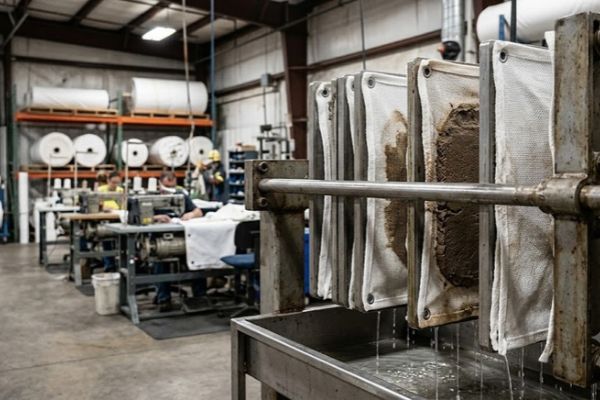
Filter press cloth is a specially designed filtration fabric installed over the plates of a filter press machine. During operation, slurry enters the filter press under pressure.
The liquid passes through the filter cloth, while solid particles remain on the surface and form a filter cake. The filtered liquid is then collected for further processing, reuse, or disposal.
The filter cloth works as the main filtration media, which makes its fabric quality, weave, strength, pore structure, and size important for overall filter press performance.
How Does Filter Press Cloth Work?
A filter press operates through a simple filtration process.
First, slurry containing both solid and liquid particles enters the filter press chambers. Pressure pushes the liquid through the filtration cloth.
The filter cloth allows liquid to pass while holding solid particles inside the chamber. These solids slowly form a cake on the cloth surface.
After the filtration cycle is complete, the plates are opened and the filter cake is removed.
A properly selected filter press cloth helps provide:
- Efficient solid-liquid separation
- Better filtration accuracy
- Clearer filtrate
- Uniform filter cake formation
- Faster filtration cycles
- Easy cake removal
- Reduced leakage
- Longer filtration media life
Filter Press Cloth Manufacturer for Industrial Applications
Different industries process different types of slurry. Therefore, one filter cloth may not work equally well for every application.
An experienced Filter Press Cloth Manufacturer considers factors such as the type of slurry, particle size, chemical characteristics, operating pressure, temperature, required filtration level, and filter press design before recommending filtration media.
Madhusudan Garment Filter Bags offers filter press cloth solutions for different industrial filtration requirements. Cloths can be selected according to machine size, process conditions, and filtration needs.
Types of Materials Used for Filter Press Cloth
The material used for filter press cloth has a major effect on filtration performance and cloth life.
Polypropylene Filter Press Cloth
Polypropylene, commonly known as PP, is widely used for industrial filter press applications.
PP filter cloth provides good resistance against many chemicals and is suitable for various solid-liquid separation processes. It is commonly used in chemical processing, wastewater treatment, food processing, pharmaceuticals, and other industries.
Polyester Filter Cloth
Polyester filtration fabric provides good mechanical strength and wear resistance.
It can be suitable for applications where durability, dimensional stability, and repeated filtration cycles are important.
Nylon Filter Cloth
Nylon provides good strength and abrasion resistance. It can be selected for processes where the filtration media experiences regular mechanical stress.
The right material should always be selected according to the actual process conditions rather than only the cost of the cloth.
Important Features of Quality Filter Press Cloth
High Filtration Efficiency
A well-designed filter cloth provides effective separation between liquid and solid particles while maintaining suitable flow.
Strong Fabric Construction
Industrial filtration may involve significant operating pressure. Strong fabric construction helps the cloth maintain its shape and filtration properties.
Chemical Resistance
Many industrial processes contain acids, alkalis, solvents, or other chemicals. The filtration material should be compatible with the process fluid.
Good Cake Release
Easy removal of the filter cake can reduce cleaning time and improve productivity.
Accurate Size and Fitting
Filter cloth should properly match the dimensions of the filter press plate. Incorrect fitting can cause leakage, uneven filtration, and premature cloth damage.
Long Service Life
A durable filter cloth helps reduce frequent replacement and supports continuous industrial operations.
Industries Using Filter Press Cloth
Filter press filtration is used across many industries where solid-liquid separation is required.
Common industries include:
- Chemical processing
- Pharmaceuticals
- Textile processing
- Food and beverage
- Edible oil processing
- Ceramic industries
- Mining and minerals
- Metal processing
- Paper and pulp
- Paints and pigments
- Wastewater treatment
- Effluent Treatment Plants
- Sludge dewatering plants
- Industrial water treatment
Every industry has different operating conditions, so the filter press cloth should be selected according to the application.
How to Choose the Right Filter Press Cloth
Selecting filtration cloth should involve more than simply matching the plate size.
Consider the following factors:
Type of Slurry:
Understand whether the slurry is fine, coarse, sticky, abrasive, acidic, alkaline, or chemically aggressive.
Particle Size:
Smaller particles may require a tighter filtration structure.
Operating Pressure:
Cloth strength should be suitable for the pressure generated by the filter press.
Temperature:
Confirm that the selected material can operate safely at the required process temperature.
Chemical Compatibility:
The fabric should withstand chemicals present in the slurry.
Cake Release:
Industries requiring frequent cycles should consider how easily the filter cake separates from the cloth.
Machine Design:
Plate size, plate type, feeding arrangement, and discharge system should also be considered.
Working with an experienced filter press cloth supplier can help industries select suitable filtration media based on these requirements.
Filter Press Cloth Manufacturer in Ahmedabad
Ahmedabad has a strong industrial base covering chemical processing, pharmaceuticals, textiles, engineering, food processing, ceramics, and wastewater treatment.
Madhusudan Garment Filter Bags serves businesses looking for a Filter Press Cloth Manufacturer in Ahmedabad with filtration solutions suitable for different industrial requirements.
Businesses can select filter press cloth according to their machinery, slurry type, filtration conditions, and application requirements.
Filter Press Cloth Manufacturer in Gujarat
Gujarat is home to major industrial areas covering chemicals, pharmaceuticals, dyes, textiles, engineering, ceramics, food processing, and manufacturing.
Industries located in Ahmedabad, Vadodara, Bharuch, Ankleshwar, Surat, Vapi, Rajkot, Morbi and other industrial regions may require dependable filtration media for their process and wastewater filtration systems.
As a Filter Press Cloth Manufacturer in Gujarat, Madhusudan Garment Filter Bags provides filtration solutions for different industrial applications.
Filter Press Cloth Manufacturer in India
Industrial filtration requirements vary significantly between sectors.
For businesses searching for a Filter Press Cloth Manufacturer in India, product selection should focus on filtration efficiency, fabric quality, chemical compatibility, accurate dimensions, and dependable supply.
Madhusudan Garment Filter Bags provides industrial filtration products for customers across India and supports different filtration requirements with suitable product options.
Why Choose Madhusudan Garment Filter Bags?
Choosing the correct filtration partner can help improve machine performance and reduce filtration problems.
Madhusudan Garment Filter Bags focuses on providing industrial filter products designed for different filtration applications. Customers can discuss their machine details, filtration process, slurry characteristics, operating conditions, and required cloth dimensions before selecting the appropriate solution.
The company provides solutions for industries requiring dependable solid-liquid filtration and industrial filtration media.
Conclusion
Filter press cloth plays a critical role in the performance of a filter press machine. The correct cloth helps separate solids from liquids efficiently, improves cake formation, supports clear filtrate, and keeps filtration cycles running smoothly.
Businesses should select filter cloth based on fabric material, particle size, slurry characteristics, temperature, chemical exposure, operating pressure, and filter press design.
If you are searching for a reliable Filter Press Cloth Manufacturer in Ahmedabad, Gujarat, or India, Madhusudan Garment Filter Bags provides industrial filtration solutions suitable for different applications and process requirements.
FAQs
Filter press cloth is used as filtration media in a filter press machine to separate solid particles from liquids during industrial processing.
Polypropylene or PP is commonly used because of its filtration properties, strength, and resistance to many industrial chemicals.
Selection depends on slurry type, particle size, operating pressure, temperature, chemical compatibility, filtration requirement, and filter press plate size.
Yes. Filter cloth dimensions and designs can be selected according to different filter press plates and application requirements.
It is widely used in chemicals, pharmaceuticals, textiles, ceramics, food processing, mining, wastewater treatment, ETP plants, and many other industries.
Replacement frequency depends on operating conditions, filtration cycles, chemical exposure, cleaning practices, and cloth condition. A cloth should be inspected regularly for damage or reduced performance.
Clogging can occur because fine particles become trapped inside the fabric pores. Regular cleaning and selecting the correct cloth for the application can help reduce clogging.
Yes. Cloth material, permeability, pore structure, strength, and condition can directly affect filtration speed, filtrate clarity, cake formation, and overall machine performance.