



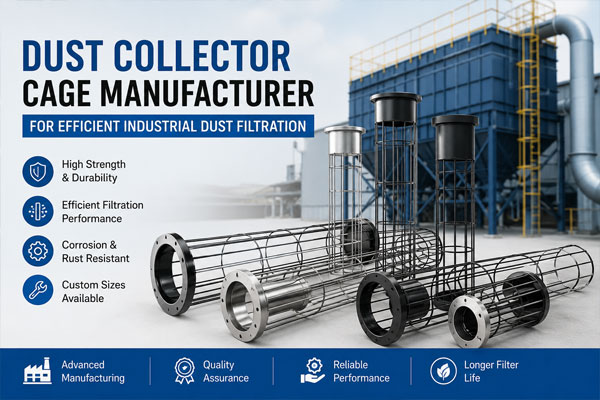
Dust Collector Cage Manufacturer for Efficient Industrial Dust Filtration
Industrial plants generate dust during grinding, mixing, cutting, crushing, conveying and manufacturing processes. When this dust is not controlled properly, it can affect air quality, damage machinery, reduce production efficiency and create an unsafe working environment.
A baghouse dust collector helps capture airborne particles before clean air is released from the system. Inside the dust collector, filter bags trap the dust while metal cages provide structural support to the bags. The correct cage helps the filter bag maintain its shape and perform properly during filtration and cleaning cycles.
Madhusudan Garment Filter Bags is a trusted Dust Collector Cage Manufacturer in Ahmedabad, offering durable cage solutions for baghouse dust collection systems. The company supplies dust filtration products for cement, chemical, power, ceramic, metal, mining, food processing and other industries.
What Is a Dust Collector Cage?
A dust collector cage is a rigid metal structure installed inside a dust filter bag. It is also known as:
- Filter bag cage
- Dust filter cage
- Baghouse cage
- Dust collector filter cage
- Filter bag supporting cage
- Pulse-jet filter cage
In a pulse-jet baghouse, dusty air generally passes through the filter bag from the outside to the inside. The filter bag captures dust particles while clean air moves through the fabric. The internal cage prevents the bag from collapsing under airflow and pressure changes.
The cage must be smooth, correctly sized and properly aligned. Poor cage construction can cause unnecessary rubbing, punctures, deformation and early filter bag failure.
Industrial Applications of Dust Collector Cages
Cement Plants
Dust collector cages are used in cement mills, clinker units, packing plants, crushers and material-handling systems.
Power Plants
They are used in boiler bag filters, fly-ash handling systems and other dust-control applications.
Chemical Industries
Chemical production can generate fine and corrosive dust. The cage material and coating should be selected according to the process.
Pharmaceutical Plants
Dust collection systems help control powders produced during mixing, granulation, compression and material transfer.
Food Processing Units
Filter cages may be used in flour, spices, grains, starch, sugar and other dry food-processing applications.
Metal and Foundry Industries
They support dust filter bags used for furnaces, grinding, polishing, shot blasting and metal-processing operations.
Ceramic Industries
Ceramic powder, clay and mineral dust can be collected using suitable baghouse filtration systems.
Asphalt Mixing Plants
Filter cages support bags used for collecting dust generated during asphalt production and aggregate heating.
Dust Collector Cage Maintenance and Inspection Guide
Introduction to Dust Collector Cage Maintenance
Regular maintenance helps prevent filter bag damage and keeps the dust collection system working efficiently.
Importance of Cage Inspection
Routine inspection helps identify rust, bending, broken wires and sharp welding points before failure occurs.
Common Causes of Cage Damage
Corrosion, high temperature, moisture, vibration and improper handling can damage dust collector cages.
Signs of a Damaged Filter Cage
Frequent bag punctures, dust leakage, reduced airflow and uneven cleaning may indicate cage problems.
Vertical Wire Inspection
Check vertical wires for bending, breakage, corrosion and sharp edges that may damage filter bags.
Horizontal Ring Inspection
Inspect support rings for loose joints, broken welds and uneven spacing.
Conclusion
A dust collector cage is a small but important part of a baghouse filtration system. It supports the filter bag, prevents collapse and helps the bag move correctly during pulse-jet cleaning.
The cage must have accurate dimensions, strong welding, uniform wire spacing and a smooth surface. Its material and coating should also match the temperature, moisture and chemical conditions of the process.
Madhusudan Garment Filter Bags offers durable dust collector cage solutions for cement, power, chemical, ceramic, food, metal, mining, pharmaceutical and other industrial applications. By selecting the right cage, industries can improve filtration performance, reduce maintenance and extend filter bag life.
Frequently Asked Questions
A dust collector cage is a metal support structure installed inside a filter bag. It keeps the bag open and prevents it from collapsing during filtration and cleaning.
The cage maintains the shape of the filter bag under negative pressure. It also supports the bag during compressed-air cleaning.
Common materials include mild steel, galvanized steel and stainless steel. Special surface coatings may also be used for corrosive environments.
A venturi helps direct compressed air into the filter bag during pulse-jet cleaning. Its requirement depends on the dust collector design.
Yes. Cages can be manufactured according to the required diameter, length, wire configuration, collar, bottom cap, venturi and material.
Measure the cage length, outer diameter, wire thickness, number of vertical wires, ring spacing, top collar, bottom cap and venturi. Providing an existing sample or technical drawing is recommended.
A cage should not be reused if it has broken wires, sharp edges, severe corrosion, loose joints or major bending. A damaged cage may puncture a new filter bag.
A one-piece cage has a continuous structure. A multi-piece cage contains sections that are joined during installation and is useful for long bags or restricted installation spaces.
An incorrectly sized or poorly finished cage can cause rubbing, folding, punctures, uneven cleaning and premature filter bag failure.
Madhusudan Garment Filter Bags manufactures and supplies dust collector cages and filter bags for different industrial baghouse filtration applications in Ahmedabad, Gujarat.